Showing posts with label Encounters. Show all posts

Tuesday, 25 March 2014

Brachiosaur Artillery Crew

Dominic Matte
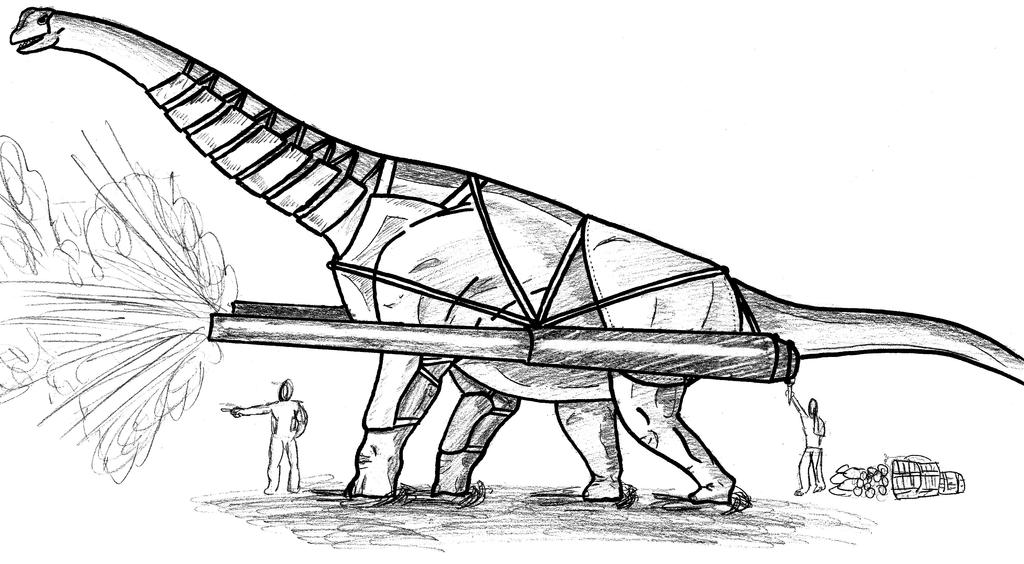
In one of the D&D games I'm running, The Long Game, there's a country - Aurum - whose military makes heavy use of the large exotic animals and monsters that exist in a fantasy world. Since it's my game and I do what I want, Aurum's artillery units are armoured brachiosaurs with massive cannons strapped to their sides.

I've been meaning to sketch one of these artillery brachiosaurs for some time, and finally got around to it today. But as I was drawing I started thinking about exactly how these things would work in combat, so I ended up writing stat blocks for the brachiosaur and its crew.
click to embiggen

Saturday, 22 March 2014

Dynamic Encounters: Monsters Ate My Money

Dominic Matte
Today I ran the first D&D session I've done in months! Hooray! Two of the three encounters were relatively simple compared to what I've been used to planning for The Long Game, but for the third I decided I'd try something different: tying the party's pay directly to their performance in combat.

Here's the setup: rust monsters are attacking the mining camp, and the party is charged with defending 10 stacks of pure steel ingots scattered across the battlefield. For each stack that survives the fight, the party earns 250g - or for those not inclined to simple math, 2500g if they manage to protect every stack. The catch is that the rust monsters can break down an entire stack of ingots with one standard action, so the party needed to control the bugs' movement and burn them down as fast as possible.

As the PCs were surprised by the attack, the first couple of rust monsters managed to consume a couple of piles of ingots in the first round or two. This group of players is pretty strong on damage - despite rusting weapons and the barbarian's loss of his greatspear, they managed to down the beasts pretty quickly. They were a little light on control, though, so despite the warforged fighter blocking access to one group of ingots, the party ended up losing a couple more stacks as the fight went on. They ended the battle with six stacks surviving, and so they earned 1500g as their reward.

Probably the high point of the battle was the heightened tension when a swarm of baby rust monsters latched on to the warforged and started eating away at his steel plating. Fortunately he survived relatively unscathed.


Friday, 4 October 2013

Building A Scarier Scarecrow

Dominic Matte
It's October, and Halloween is getting closer, so when I think about D&D I think a little more about horror elements than I usually do. 

Scarecrows have been D&D monsters for quite a long time - since the beginning, really. I've only been playing since 3rd edition, but the internet tells me that the scarecrow goes all the way back to the 1e Fiend Folio.The common themes behind all versions of the scarecrow are that it's a form of construct made of straw, and that its purpose is to scare in order to protect something. In real life that something is crops, and the scarecrow is scaring off birds (like crows) by making them think a human is present.

But looking at 4e's scarecrows, they don't really sell the horror for me. I've come up with a different approach that I think makes them much scarier.

Friday, 12 July 2013

Solo Design: Positioning Matters

Dominic Matte
In a recent session I ran a battle in which positioning and control were extremely important. Positioning and movement are sometimes (maybe often) ignored even in highly tactical 4e combat because most of the time, if you're in range, your precise location isn't really that big a deal. The fighter can hit the orc and he's blocking the path to the wizard? Great, he doesn't need to move unless the orc goes for the wizard.

I wanted to run a fight where position would be the most important element of the battle. Here's how I approached that goal.

Saturday, 13 April 2013

Aliens

Dominic Matte

Almost all of our posts recently have been about our current ongoing D&D campaign, The Long Game. So, to change it up, here's something completely unrelated and possibly a little silly. Since I may never get to run these in an actual game, I present to you my adaptation of the xenomorphs from the Alien movies as D&D 4e monster stats.

Monday, 14 January 2013

The Maze with the Invulnerable Guardian

Dominic Matte
Check out this post for a download link to run the dungeon yourself - it's suitable for parties of level 2 to 4.

I've been DMing for 8 years and I've never actually run a proper dungeon, so recently I decided I'd try my hand at it. I didn't want to run just a series of rooms with fights and treasure in them, so I figured I'd need one or two unique mechanics that run through the whole dungeon and tie everything together, so that each room feels like part of one big encounter rather than isolated battles or puzzles.

I settled on a maze with a phasing invulnerable guardian. That probably sounds a lot scarier than it actually was, though I'll admit that it was in fact pretty scary.

Monday, 23 April 2012

Metagaming the Metagamers: Unwinnable Encounters

Dominic Matte
This article is part of a series on metagaming and how to challenge or discourage it in your games.

Some players assume that their DM wouldn't give them a challenge they can't beat. This can mean combat encounters, skill challenges, puzzles -- whatever. This isn't a terrible assumption to make, but it can cause problems on both sides of the screen. The players can get themselves into an extremely dangerous situation and risk one or more character deaths, and the DM might lose control of a key scene or plot point.

How do you teach your players that some challenges can't be beaten? Give them a challenge they can't beat.

Thursday, 19 April 2012

Metagaming the Metagamers: Minions

Dominic Matte
In a previous article I looked at the definition and a few examples of metagaming. There are many ways to deal with metagaming players, such as simply talking to them and explaining that a really good roleplayer acts only on information known by the character, or that the player's metagaming is having a negative effect on the game.

The more entertaining (and possibly evil) option is to observe how your players metagame, build situations and encounters to exploit their thinking, and teach them a lesson by turning their expectations on their heads.

This time I'm taking a look at how you can use minions in an encounter to force players to reconsider their assumptions.

Saturday, 14 April 2012

Dynamic Encounters: King-of-the-Hill

Dominic Matte
Looking for ways to keep your combats engaging and exciting? The Dynamic Encounters series will get you started!

A good way to keep encounters exciting is to use special terrain features that change the rules of the battle in a small area. Features that give bonuses will be contested points that everyone wants to hold, leading to frantic races and struggles for territory. 

The terrain features in the Dungeon Master's Guide(s) can do a pretty good job of this, but they tend to be smaller terrain features. If you want an entire battle to be about a desperate struggle to capture and hold a single location, try a king-of-the-hill battle.

Thursday, 29 March 2012

Solo Design: Geomancer

Dominic Matte
Solo Design is a series of articles exploring solos -- monsters designed to engage an entire party -- using monsters I've designed for my own games.

What's the easiest way to create a really dynamic encounter that forces the players to think on their feet? To run a monster that alters the battlefield itself, of course! I wanted a dynamic encounter, so what better way to do that than to build a monster that alters the battlefield to his advantage every single turn?

Brigadier Stonefist is a high-ranking military officer and geomancer. He's a goliath with the ability to move and control the earth and stone around him. In combat, Stonefist is a tough and durable controller who focuses on splitting up and engaging the party one at a time. He can take a flat, boring battlefield and turn it into a blasted rocky maze of a wasteland in only a few turns.

Sunday, 11 March 2012

Better Minions Part Two: Tactical Minions

Dominic Matte
A lot of the official D&D 4e published material doesn't make very good use of minions. Much of the time they're just extra bodies to distract and slow down the players, rather than actual tactical elements. Here are a few ideas to make minions more interesting in combat. Use these with either regular minions or two-hit minions.